
Grimlock ♥ Ultra Magnus
I'm a well read grad student who's bluntly honest about all things, although I try to be most honest about myself.
Currently reading


Brava!
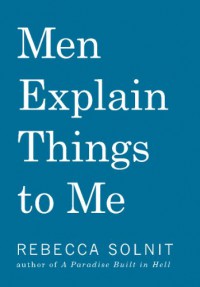
"Six years ago, when I sat down and wrote the essay 'Men Explain Things to Me,' here's what surprised me: though I began with a ridiculous example of being patronized by a man, I ended up with rapes and murders. We tend to treat violence and the abuse of power as though they fit into airtight categories: harassment, intimidation, threat, battery, rape, murder. But I realize now what I was saying is: it's a slippery slope. That's why we need to address that slope, rather than compartmentalizing the varieties of misogyny and dealing with each separately. Doing so has meant fragmenting the picture, seeing the parts, not the whole."
So, this has taken me an embarrassingly long time to finish, because it's an excellent and important book. I kept having to put it aside: the details, the numbers, dealing with sexual assault and violence against women were too upsetting, or I had to really sit down and think about things.
And rather than a review, this is going to be about how this book has affected me already. It's going to be a long, possibly offensive to some, essay on my own interactions with a specific male in my life.
My therapist is a lovely, elderly man, who is in no ways violent towards women. He treats them as if they are intelligent, and he has told me on many occasions that I am quite bright, and he treats me accordingly.
However, he also has very often treated me as if I have no agency. At one point, I was so disturbed by one thing I told him if he told me one more thing about it, I would pick up my bag and leave. He continued going on about the matter. He later said he interpreted this as I didn't want details, and he was going to tell me something vague. My comment of 'no, I don't want to talk about this at all,' was ignored; he wanted to say something, to me in particular, and I had no rights to say no. Which I said loudly, and multiple times.
Another time, I was complaining about a book that dealt with the Holocaust offensively. I wanted to complain about the reactions: that this was a well written book, it wasn't meant to be offensive. I didn't want to talk about the details of the camp, as I've had nightmares about a monster tarantula that was as big as my bed since I've been told that my grandfather's whole family was killed in the Holocaust, including his young sister. My sister was around the same age - two or three - when I learned this, and I freaked out. (The tarantula, by the way, was on it's back, scrabbling to get away as I slept in my bed; it had sharp, shap points at the end of its legs.) When I said, no, under no circumstances did I want to know about the camp, he insisted. Later he said he was trying to help me, and trying to understand, because maybe by exposure I could overcome this. To which I replied why did you not even bother to ask me why I didn't want to talk about it, if you were trying to understand and help?
See, the concept of an empty vessel was brought up in this book. By insisting that he has good, good knowledge, and that he must relate this knowledge to me - and damn if I want to know it - he takes away my agency. I am an empty vessel, which he can fill with said good, good knowledge.
He had struggled with this concept until I put it this way. There are other problems. He has told me that he's concerned that I am not as curious about everything as he is. He wants to force me to open up my boundaries, and learn more, and that he is going to chose what I need to learn. Because, apparently as an adult woman, I am not allowed to choose what I learn on my own time: I like comics and Transformers? Fine, but why can't I know about history and science, and the things he thinks I should know about? Won't I regret not knowing these things?
To which I responded that I was an adult, I was responsible for my own choices, and he was not, and if I regretted not knowing these things, they were my mistakes to make. Furthermore, it was quite patronizing that he got to choose what I learned. On my own damn time.
There are yet more problems: when I tell him that this feels like a violation of sorts, he gets all offended. It's not rape! No, certainly it is not, but it is a violation of sorts. It is telling me that my wants and needs are not important; it is the same thing that a man says when he rapes someone, I argued. He is saying that her wants are not as important as his: he wants sex, and he's going to get it dammit, whether or not she wants sex.
Just like he wanted to tell me and he was going to tell me, dammit, whether or not I wanted to know anything. To make matters worse, when he asked me what he could do to make our relationship better, I asked him not to ask me the same questions or dig into something when I continually answered no. Not five minutes later, he insisted I knew what a pasta maker was, even after I told him I did not multiple times. I have no interest in cooking. But surely I'd seen one in a magazine, in a cooking store, etc, etc. I had not, I insisted. When I told him that it was pointless to ask me what not to do if he wasn't going to listen, and hammered home this point, he got defensive once again.
When I brought it up in a later session, he stunned me by putting his fingers in his ears, and saying, 'lalalala.' There were other things happening: he had needed to see a doctor himself due to pain, and admitted he shouldn't have seen me that day. Regardless, I told him that if he didn't want to hear about that incident - and he clearly no longer wants me to speak about it - then it was a double standard if he blew through my claims of 'no.'
I've never gotten a good answer to the question of me not being clear enough, either. He claims sometimes I am too vague. When I asked him how my claims of 'no,' repeated claims, or even 'I don't want to hear a single thing, even a positive thing about this,' were too vague, I never got a good answer, even when I pressed him about it.
It still feels like a violation. It takes away my agency, my power, and my voice. It renders me silent, it tries to make me the meek little girl who listens to the man who knows what's best for me. It's not rape, no, but he got most defensive when I said that the thought behind it - that his needs were more important than mine - were the same. He still refuses to accept this.
There are many ways to strip a woman of power, and this is one way. It's not as traumatic as rape, it's not the same, but the machinery behind them both is the same. When you compartmentalize, when you say that stripping a woman of rights one way is different, and less bad, than another, you normalize that. Furthermore, this is a man who is in a position of power. I consider him a friend, as he considers me a friend, but it's easy for him to take away my power - and my confidence.
Many times when I present my arguments logically, he lashes out at me. At one point he called me Mrs. Prosecutor. He feels persecuted, he feels as if I try to make him feel small. Why is it that I am I not allowed to speak freely, to make my needs known, to evaluate why it is okay for him to break through my walls and boundaries, without him making me feel bitchy? Was it, I asked him once, that it was fear of the facts: I was a woman presenting these facts to him logically. Could he possibly be afraid that I was right?
Or when I asked if he would treat a male patient the same way, he said he would and he has. When I argued that it was impossible for me to know as I've never seen him interacting with a male, he insisted this was true. But he also wants to treat women equally, very badly, and the kind of cultural integration of misogyny that we are bombarded with and that we take in daily is hard to purge. Memories are tricky things: we want to treat people equally, so sometimes we remember ourselves doing so even if it might not be the case. Could he be sure? How could I know without seeing him with male patients, which would be impossible? I never got a satisfactory answer to this, either.
But the compartmentalization continues. It makes it easier to normalize silencing woman, to ignore their needs, to ignore when they say stop - so long as you're not raping them. And remember, women, you're not being violated unless you're being raped. All those other ways of stripping you of your agency and power? They're just not as bad. Saying that they are a violation is comparing someone to a rapist, even when you're careful to make that distinction yourself.
Or so the thinking continues to go. Merriam-Webster disagrees:
"violation
: the act of doing something that is not allowed by a law or rule
: the act of ignoring or interfering with a person's rights
: the act of showing disrespect for something (such as a holy place) usually by damaging it"
"The act or ignoring or interfering with a person's rights."
Such as, say, my right to learn what I want when I want, or my right to disengage from a conversation.
"The act of showing disrespect for something..."
Such as, say, disrespecting me by ignoring my pleas to stop talking about something that is bothering me, in a confined space.
I still feel violated. It bothers me. It has caused a lot of inner turmoil. And I felt alone until I read this book; I felt unable to truly comprehend what this meant, and I felt unable to express it in a way that made an impact. I only started when I was halfway through this book.
The empty vessel example from this book actually worked. When I presented my argument framed by Solnit's ideas, it made an impact, and it made sense to him.
So before I start crying, I'm going to end this, and say thank you, Rebecca Solnit. You've changed so much for me, and I'm sure will continue to do so as I continue to mull over this book. You've given me the confidence and ability to continue to fight the good fight, to be treated as an equal, and a person with agency.
You'll never know that you changed my life, but you did. You wrote an essay for a friend's sister, and it's not only brilliant, it has the ability to make women think more - and more clearly - about the situations they find themselves in today. It gives them a way to speak - and speak more clearly - about their situation.
It's a debt to me, and I hope many others, that we can never repay.
Thank you, thank you, thank you.
PS - I'm sorry this was so long, so personal, and for some perhaps maybe so weird. I got so excited as soon as I finished this, and I needed to write this.
 28
28
 19
19